Youth Homelessness in Canada: A Crisis We Often Ignore
Written by Anthony Zinchenko
Anthony is a high school student passionate about raising awareness about youth homelessness and supporting organizations like Youth Without Shelter (YWS). He is the author of the blog post Youth Homelessness in Canada: A Crisis We Often Ignore, which aims to shed light on the realities many young people face and why the issue deserves greater public attention. Through clear and accessible writing, Anthony hopes to help students and families better understand youth homelessness and the role communities can play in addressing it. He also believes strongly in the power of youth supporting youth, and how awareness, advocacy, and grassroots activism can inspire meaningful change.
Help Anthony Fundraise HERE
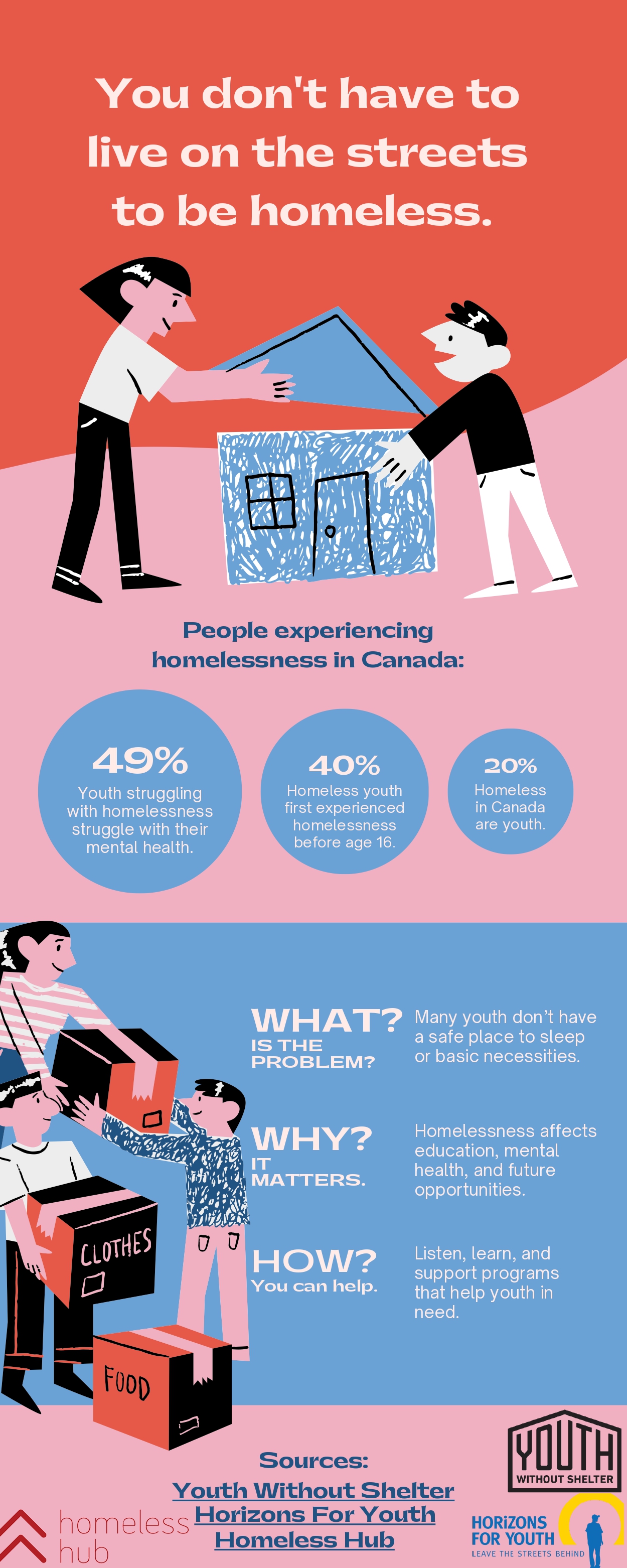
Youth homelessness is a significant and often overlooked social issue in Canada. Everyone is exposed to harsh realities, such as mental health issues, and an unpredictable future adds to the stress and anxiety we face daily. Youth homelessness is a part of this harsh reality, the side of the reality that we often choose to ignore. According to the Canadian Observatory on Homelessness, approximately 35,000 to 40,000 youth between the ages of 13 and 24 experience homelessness in Canada.[1] This blog post aims to discuss the reasons that lead to youth homelessness in Canada, the forms of youth homelessness, and the responsibility of our society to deal with this issue.
In order to understand the problem of youth homelessness, we need to understand the origin of this problem. Family conflicts are often considered to be the major reason for homelessness. Studies conducted in Canada have revealed that more than 60-70% of homeless youth experience physical, emotional, verbal, or sexual abuse by family members before becoming homeless.[2] Housing costs, along with a lack of access to mental health services, also contribute significantly to youth housing instability. All these hurdles in the pathway to a youth’s childhood lead to a cycle that is hard to break without proper assistance.
It is a frightening thought to think that people my own age and older are facing this problem. Youth homelessness is not always in the form that one would expect. According to the Canadian Observatory on Homelessness, this is known as “hidden homelessness”.[3] This includes youth living with friends or extended family members, moving from one place to another, and being quiet while trying to go to school or work without openly seeking help. Most youth facing this problem are not on the street and therefore can be easily overlooked by society.
As a young person in this society, I may not have the power to make a change on my own, but I have the power to listen to and advocate for these issues. Studies have shown that prevention programs and youth housing facilities are vital in reducing youth homelessness.[4] By realizing that youth homelessness is our responsibility as a society, we will become a more supportive society where no young person feels left without a place to belong.
_______
[1] Bill O’Grady, Kaitlin Schwan, Sean Kidd, Stephen Gaetz, Without a Home: The National Youth Homelessness Survey, accessed March 2, 2026, https://homelesshub.ca/resource/without-home-national-youth-homelessness-survey/
[2] Horizons for Youth, Thinking Differently: Reframing “Family”, accessed March 2, 2026, https://horizonsforyouth.org/blog/2019/9/11/family
[3] Canadian Observatory on Homelessness, Canadian Definition of Youth Homelessness, Homeless Hub, accessed March 2, 2026, https://homelesshub.ca/resource/canadian-definition-youth-homelessness/
[4] Horizons for Youth, Youth Homelessness in Canada, accessed March 3, 2026, https://horizonsforyouth.org/aboutyouthhomelessness/